An updated look at how AWS and other hyperscalers are transforming banking in 2025 — a follow-up to my original post, “Big Banks Will Be Big Business for AWS.”
In 2018, I wrote that big banks would soon become big business for AWS. At the time, many financial institutions were still cautious, testing cloud waters through pilots and peripheral workloads.
Fast forward to 2025, and that prediction has not only come true but accelerated beyond expectations. The banking sector has become one of the most dynamic growth arenas for hyperscale cloud providers, reshaping how global financial systems are built, operated, and innovated.
“The era of cautious cloud pilots in banking is over. Global financial institutions are now modernizing their core systems in the public cloud.”
Why the Shift?
Several forces have converged to make large-scale cloud adoption in banking inevitable:
Cybersecurity urgency: The surge in AI-powered attacks and sophisticated fraud schemes continues to push banks toward more adaptive, scalable, and resilient architectures
Cloud maturity: AWS, Microsoft, and Google have expanded regulated-industry capabilities with audit transparency, encryption controls, and sovereign cloud options.
Business pressure: Banks face mounting demands for agility, cost optimization, and digital innovation.
Regulatory clarity: Supervisory bodies from the OCC to the ECB now provide structured cloud guidance, enabling safe deployment of even mission-critical workloads.
Press enter or click to view image in full size
2025 Benchmark Data & Market Trends
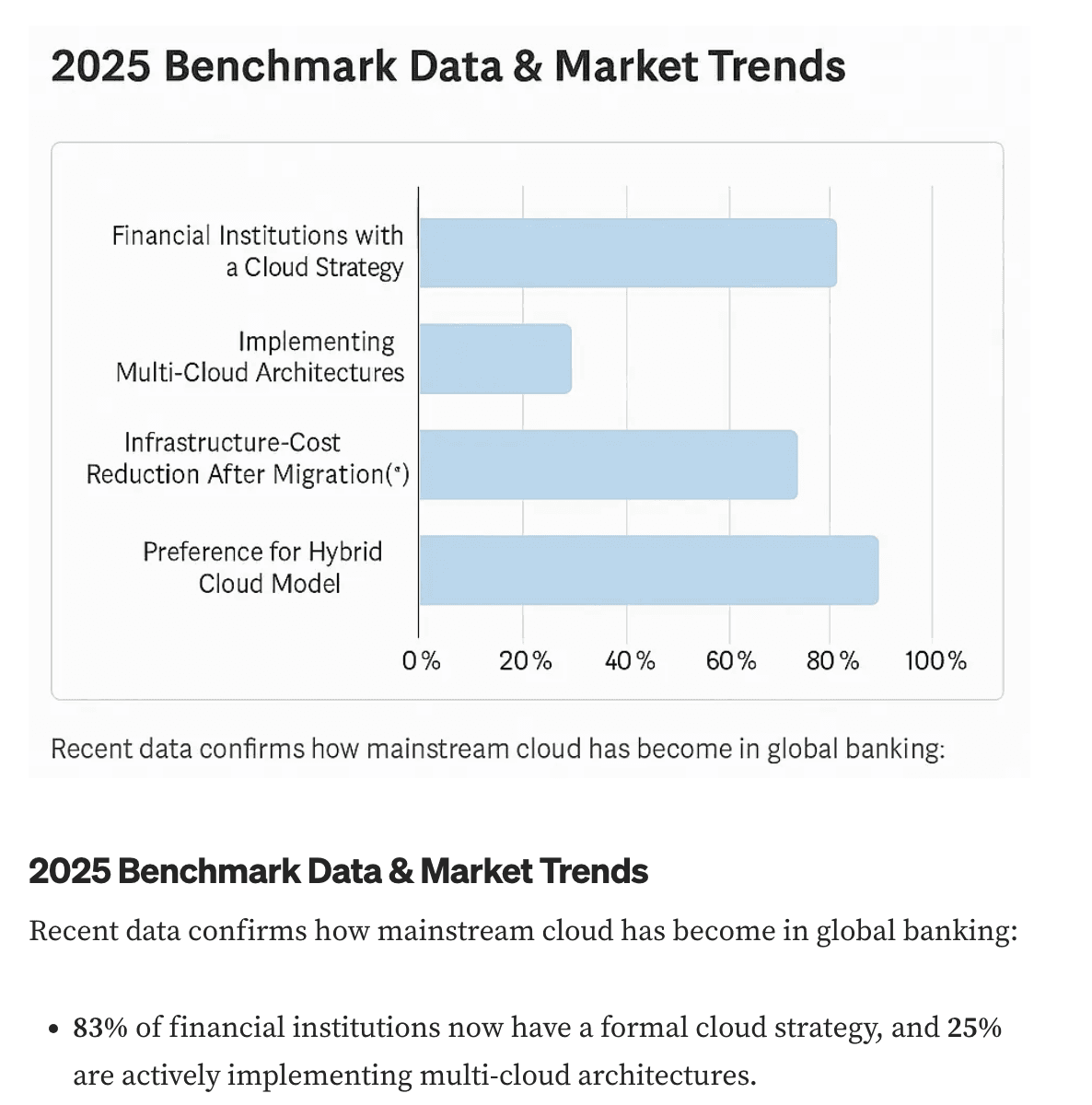
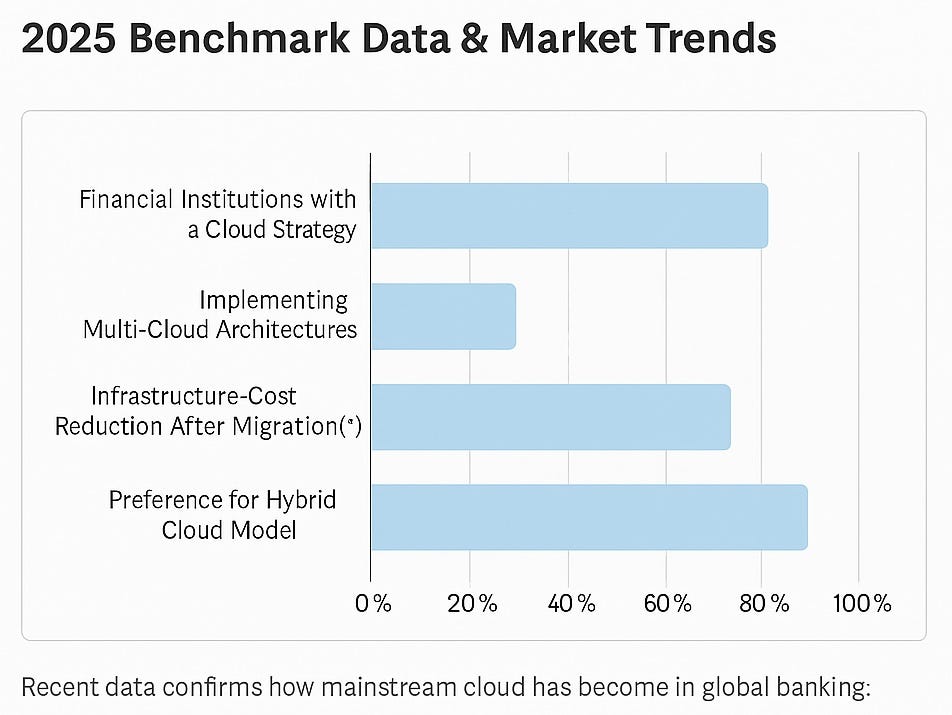
Recent data confirms how mainstream cloud has become in global banking:
83% of financial institutions now have a formal cloud strategy, and 25% are actively implementing multi-cloud architectures.
Average infrastructure-cost reduction after migration: ~27%, with some achieving ~34% savings over three years.
Market share (financial sector): AWS leads with 41.6%, followed by Azure (29.3%) and Google Cloud (18.5%).
Sixty-four percent of institutions report a preference for a hybrid model that balances latency, data sovereignty, and regulatory compliance.
AWS’s Banking on the Cloud 2025 report highlights new priorities: generative AI, composable banking, and real-time data ecosystems driving revenue and risk insights.
“In 2025, cloud adoption isn’t about cost savings — it’s about competitiveness, data velocity, and speed to innovate.”
Real-World Cloud Migration Highlights
Cloud adoption is no longer theoretical. Leading banks are executing large-scale transformations:
BBVA (Spain). Migrated its global data platform to AWS across Europe and Latin America in 2024–2025, supporting tens of thousands of analytical processes and AI models.
Danske Bank (Denmark). Moved ~16,600 servers and ~25 PB of data to AWS, using hyper-automation to halve migration time and costs.
National Bank of Canada. Completed a nine-month migration of 2,300 virtual servers to AWS — a record pace for the institution.
These cases illustrate a broader truth: financial giants now treat cloud not as a risk, but as a competitive moat.
Where Banks Are Deploying Cloud Today
Banks are scaling deeper into their technology stack:
Data & Analytics: Real-time risk modeling, fraud detection, and customer insights.
Core Platform Modernization: Payment rails, trade settlement, and treasury systems.
Fintech Collaboration: Cloud platforms enable banks to launch digital-only brands and embed fintech services.
Hybrid & Multi-Cloud: Balances compliance, performance, and modernization velocity.
What AWS (and Peers) Must Deliver
Defense-in-Depth Security: Encryption, zero-trust design, continuous monitoring.
Regulatory & Audit Alignment: Transparent controls for PCI-DSS, GDPR, BCBS-239.
Operational Resilience: Multi-region failover, immutable backups, and rapid recovery.
Visibility & Governance: Banks maintain encryption-key control and architectural transparency.
Innovation Enablement: ML services, data lakes, and sandbox environments for fintech collaboration.
What This Means for the Banking Market
AWS is now a strategic infrastructure partner to global Tier-1 banks.
Competitive differentiation comes from how fast banks can harness AI, analytics, and embedded finance.
Institutions slow to modernize risk being out-paced by fintech challengers.
Providers with bank-grade compliance expertise are becoming indispensable partners.
Key Tips for Banks Moving to AWS
Establish a strong governance framework early.
Segment workloads by risk and readiness.
Build compliance into architecture from day one.
Choose partners experienced in financial-sector audits.
Encourage safe innovation via sandbox environments.
Maintain hybrid continuity for legacy systems.
Track business value — not just cost savings.
The Bottom Line
When I first wrote that “big banks will be big business for AWS,” it was a forecast. In 2025, it’s a fact.
Major institutions like BBVA, Danske Bank, and National Bank of Canada are proof that the cloud is now central to banking’s digital core. As AI, data ecosystems, and fintech integrations expand, the relationship between hyperscalers and banks will only deepen.
“The cautious pilot phase is over. The world’s banks are all-in on cloud — and AWS, alongside its peers, is building the backbone of modern finance.”